Showing posts with label Public Appearance. Show all posts
Showing posts with label Public Appearance. Show all posts
Wednesday, July 18, 2018
Speaking At DOAG 2018 Conference And IT Tage 2018
I will be speaking at the yearly DOAG conference in December as well as at the IT Tage in November. My talk will be "Oracle Optimizer System Statistics Update 2018" where I summarize the history and current state of affairs regarding System Statistics and I/O calibration in recent Oracle versions like 12c and 18c.


Sunday, April 8, 2018
Speaking At DOAG 2018 Exa & Middleware Days In Frankfurt
I will be speaking at the DOAG 2018 Exa & Middleware Days in Frankfurt on June 18th and 19th. My talk will be "Exadata & InMemory Real World Performance" where I discuss the different performance improvements you can expect from the super fast scans delivered by those technologies depending on the actual work profile of the SQL and data used.
Hope to see you there!
Hope to see you there!
Sunday, October 9, 2016
Upcoming Public Appearances
It's that time of the year again... I'll be speaking at the following events:
- SSWUG 2016 Fall Virtual Conference: On November 15th I'll do the geeky stuff that was rejected by DOAG this year, which is "Oracle Database Parallel Execution plans deep dive - understanding the internals of Parallel Execution plans". You should only attend this session if you already have a good understanding of serial execution plans.
- DOAG Conference 2016: On November the 16th I'll present "Oracle Database Cloud Performance" where I talk about my experience regarding the performance of the Oracle DBaaS offerings. Note that some printed conference schedule material is outdated, I'll speak at 3pm, not 10am
- IT Tage 2016: On December 13th I'll present "Oracle 12c - Cost Based Optimizer Grundlagen" which describes the basics of the Cost Based Optimizer with an update how things might be different with Oracle 12c
Hope to see you at some of these events - if you're going to be there, say Hello!
- SSWUG 2016 Fall Virtual Conference: On November 15th I'll do the geeky stuff that was rejected by DOAG this year, which is "Oracle Database Parallel Execution plans deep dive - understanding the internals of Parallel Execution plans". You should only attend this session if you already have a good understanding of serial execution plans.
- DOAG Conference 2016: On November the 16th I'll present "Oracle Database Cloud Performance" where I talk about my experience regarding the performance of the Oracle DBaaS offerings. Note that some printed conference schedule material is outdated, I'll speak at 3pm, not 10am
- IT Tage 2016: On December 13th I'll present "Oracle 12c - Cost Based Optimizer Grundlagen" which describes the basics of the Cost Based Optimizer with an update how things might be different with Oracle 12c
Hope to see you at some of these events - if you're going to be there, say Hello!
Wednesday, February 24, 2016
SOUG Training Day May 2016 in Switzerland
I will be one of the speakers at the first SOUG performance training day, together with Christian Antognini, Franck Pachot and Clemens Bleile.
The event will take place in May this year in Switzerland at two different locations / days (one in German language, one in French, except mine, which will be in English).
My presentations will be:
- Analyzing and Troubleshooting Oracle Parallel Execution
- Advanced Oracle Troubleshooting
Hope to see you there!
Update: Here is the link to the official landing page of the event on the SOUG website.
Below is the official announcement published by SOUG with more details:
"Block the date ! SOUG performance training day the 18th and 19th of May exclusively in Switzerland"
In 2016 the Swiss Oracle User Group (SOUG) will introduce a new kind of event called the "SOUG training day".
During a whole day several world class speakers will teach the participants on a particular topic.
This year, Christian Antognini (Trivadis), Randolf Geist, Franck Pachot (dbi services) and Clemens Bleile (dbi services) will help the participant to manage the performances of their Oracle databases. The following topics will be addressed and explained in depth :
Strategies for Keeping Object Statistics Up-to-Date
Next-Generation Oracle Database - New Performance Features
Analyzing and Troubleshooting Oracle Parallel Execution
Advanced Oracle Troubleshooting
Interpreting AWR Reports - Straight to the Goal
All About Table Locks: DML, DDL, Foreign Key, Online Operations in regards to performance
The SOUG invites you to block the following dates to be sure that you do not miss such an incredible opportunity to meet the cracks :
- 18th of May in Olten - presentations in German
- 19th of May in Geneva - presentations in French (Mr Randolf Geist will present 2h in english)
This training day will be proposed to very attractive conditions :
- CHF 500.- for SOUG members
- CHF 1000.- for non-DOUG members
The event will take place in May this year in Switzerland at two different locations / days (one in German language, one in French, except mine, which will be in English).
My presentations will be:
- Analyzing and Troubleshooting Oracle Parallel Execution
- Advanced Oracle Troubleshooting
Hope to see you there!
Update: Here is the link to the official landing page of the event on the SOUG website.
Below is the official announcement published by SOUG with more details:
"Block the date ! SOUG performance training day the 18th and 19th of May exclusively in Switzerland"
In 2016 the Swiss Oracle User Group (SOUG) will introduce a new kind of event called the "SOUG training day".
During a whole day several world class speakers will teach the participants on a particular topic.
This year, Christian Antognini (Trivadis), Randolf Geist, Franck Pachot (dbi services) and Clemens Bleile (dbi services) will help the participant to manage the performances of their Oracle databases. The following topics will be addressed and explained in depth :
Strategies for Keeping Object Statistics Up-to-Date
Next-Generation Oracle Database - New Performance Features
Analyzing and Troubleshooting Oracle Parallel Execution
Advanced Oracle Troubleshooting
Interpreting AWR Reports - Straight to the Goal
All About Table Locks: DML, DDL, Foreign Key, Online Operations in regards to performance
The SOUG invites you to block the following dates to be sure that you do not miss such an incredible opportunity to meet the cracks :
- 18th of May in Olten - presentations in German
- 19th of May in Geneva - presentations in French (Mr Randolf Geist will present 2h in english)
This training day will be proposed to very attractive conditions :
- CHF 500.- for SOUG members
- CHF 1000.- for non-DOUG members
Sunday, February 14, 2016
Advanced Oracle Troubleshooting - One Day Seminar, Moscow
I got invited by Luxoft Training to deliver my one day seminar "Advanced Oracle Troubleshooting" in Moscow end of March.
More details about what I cover in this seminar can be found here.
If you're interested, Luxoft Training has set up a page in Russian where you can find more details - but note that the seminar language will be English.
More details about what I cover in this seminar can be found here.
If you're interested, Luxoft Training has set up a page in Russian where you can find more details - but note that the seminar language will be English.
Saturday, November 19, 2011
DOAG 2011 Unconference Wrap-Up
My sessions at DOAG all went well, and I in particular liked the Unconference ones. As promised I held two of them and they were rather different.
The first one only had a couple of attendees (including OakTable fellow Christian Antognini from Switzerland), so we could gather around my laptop and do a real "Optimizer Hacking Session". Actually we had to do that because the projector promised by DOAG wasn't there. I talked mainly about some common traps when performing SQL statement troubleshooting and what to do in order to avoid them, but also showed some cool stuff that I'll shortly blog about separately.
The second session two hours later was attended by many more than I expected, so there was no chance at all to gather around my laptop. Originally I planned to talk about some common pitfalls why the estimates of the optimizer can go wrong (even with 100% computed statistics) and what to do about, but I then realized that I should at least give a short summary of what I've shown in the first session to those that hadn't attended (which were most of the attendees anyway). This started off an interesting discussion with many questions - a surprising number revolved around the usage of user-defined PL/SQL functions.
Since even the WiFi connection didn't work properly I could only mention briefly some important articles that should be read if one wants to get a good understanding of how the optimizer can (actually should!) be helped when dealing with PL/SQL functions.
So for reference I repeat here a summary of relevant articles:
1. Expert Oracle Practices (the book I co-authored), Chapter 7, "PL/SQL and the CBO" by OakTable fellow Joze Senegacnik
2. OakTable Member Adrian Billington on pl/sql functions and cbo costing, which is inspired by Joze's work above
3. Adrian Billington on "setting cardinality for pipelined and table functions"
4. Adrian Billington's generic "Collection Cardinality Utility", for background info see the article above, the source code includes a description when and how to use it
5. The problem of the CBO ignoring the projection for costing, described on my blog
There were some other questions in the same context, for example, what would a Real Time SQL Monitoring report look like with user-defined PL/SQL functions - here is an example you can view / download (remember that the file can be shared since it is self-contained) that is taken from a query quite similar to the one described in my blog post. By the way, it's a query that gives the approach a try discussed during the session if there a chance of getting the "projection" cost right by playing clever tricks that combine projection and selection. I didn't get it to work as desired, but at least the "selection" cost showed up, which however doesn't address the actual problem of the "projection" cost in my particular test case. So Oracle still attempts to merge the views and has then to run the user-defined function many more times than necessary - in fact the query represents the worst case because the user-defined function is called for both, selection and projection.

You can see from the report that at least some PL/SQL time shows up, but it also shows a deficiency of the report - it doesn't show detailed logical I/O values, only a summary of Buffer Gets.
And interestingly, although nothing about this is visible from the end-user report, the report file itself (in the XML data section) contains at least a couple of optimizer parameter settings - to address another question raised during the session.
All in all I really liked these sessions and I hope the attendees enjoyed them as much as I did.
Last, but not least: It's not definitive yet but very likely I'll give a few free "Optimizer Hacking Sessions" in the future on the internet, so stay tuned!
The first one only had a couple of attendees (including OakTable fellow Christian Antognini from Switzerland), so we could gather around my laptop and do a real "Optimizer Hacking Session". Actually we had to do that because the projector promised by DOAG wasn't there. I talked mainly about some common traps when performing SQL statement troubleshooting and what to do in order to avoid them, but also showed some cool stuff that I'll shortly blog about separately.
The second session two hours later was attended by many more than I expected, so there was no chance at all to gather around my laptop. Originally I planned to talk about some common pitfalls why the estimates of the optimizer can go wrong (even with 100% computed statistics) and what to do about, but I then realized that I should at least give a short summary of what I've shown in the first session to those that hadn't attended (which were most of the attendees anyway). This started off an interesting discussion with many questions - a surprising number revolved around the usage of user-defined PL/SQL functions.
Since even the WiFi connection didn't work properly I could only mention briefly some important articles that should be read if one wants to get a good understanding of how the optimizer can (actually should!) be helped when dealing with PL/SQL functions.
So for reference I repeat here a summary of relevant articles:
1. Expert Oracle Practices (the book I co-authored), Chapter 7, "PL/SQL and the CBO" by OakTable fellow Joze Senegacnik
2. OakTable Member Adrian Billington on pl/sql functions and cbo costing, which is inspired by Joze's work above
3. Adrian Billington on "setting cardinality for pipelined and table functions"
4. Adrian Billington's generic "Collection Cardinality Utility", for background info see the article above, the source code includes a description when and how to use it
5. The problem of the CBO ignoring the projection for costing, described on my blog
There were some other questions in the same context, for example, what would a Real Time SQL Monitoring report look like with user-defined PL/SQL functions - here is an example you can view / download (remember that the file can be shared since it is self-contained) that is taken from a query quite similar to the one described in my blog post. By the way, it's a query that gives the approach a try discussed during the session if there a chance of getting the "projection" cost right by playing clever tricks that combine projection and selection. I didn't get it to work as desired, but at least the "selection" cost showed up, which however doesn't address the actual problem of the "projection" cost in my particular test case. So Oracle still attempts to merge the views and has then to run the user-defined function many more times than necessary - in fact the query represents the worst case because the user-defined function is called for both, selection and projection.
You can see from the report that at least some PL/SQL time shows up, but it also shows a deficiency of the report - it doesn't show detailed logical I/O values, only a summary of Buffer Gets.
And interestingly, although nothing about this is visible from the end-user report, the report file itself (in the XML data section) contains at least a couple of optimizer parameter settings - to address another question raised during the session.
All in all I really liked these sessions and I hope the attendees enjoyed them as much as I did.
Last, but not least: It's not definitive yet but very likely I'll give a few free "Optimizer Hacking Sessions" in the future on the internet, so stay tuned!
Thursday, November 10, 2011
Public Appearances
I've just got the confirmation that I have been accepted as speaker for the HotSOS Symposium 2012 in March next year, therefore I post here a quick update on my upcoming public appearances:
1. DOAG
Next week the DOAG conference 2011 (Nürnberg, Germany) will begin. It's an impressive conference with a large number of tracks, although a lot of them are not database-centred.
Nevertheless it's certainly one of the conferences to go if you speak German and are interested in Oracle database technology (or the ever increasing range of Oracle technology in general).
Since I've again missed to negotiate a training day this year (something I hopefully will be able to do next year) I've decided to compensate this a little bit: I plan to give at least two additional sessions at the DOAG "Unconference". This will be so called "Optimizer hacking sessions" where I simply start up a SQL prompt and explore some of the most important aspects of the Cost Based Optimizer. The session's title is: "Optimizer issues - How to detect and prevent suboptimal execution plans". I hope this will be fun and educating for all of us - it is meant to be an interactive session where you're encouraged to participate by asking questions that we will try to answer by performing live exploration of the database. I've got plenty of material to talk about, starting from basic SQL statement performance troubleshooting and not ending with more advanced topics like histograms, cardinality estimates, virtual columns, extended statistics, clustering factor etc. etc. Furthermore I plan to demonstrate some cool things that you probably haven't seen yet, so I believe it's going to be a lot of fun.
If you've already received the print out with the schedule (I never understand why DOAG publishes these print outs that early given all the possible changes to the schedule until the actual start of the conference): I agreed with Heli Helskyaho from Finland when we met at this year's OOW to swap our presentation slots at DOAG, so my presentation about the Cost-Based Optimizer called "Query Transformations" will not take place on Wednesday, 9 am, but on Thursday, 3 pm, room "Kiew".
Unfortunately DOAG didn't accept the second paper I've submitted that would have been the "introductionary" session about how to read and understand execution plans, so I'll only give this more advanced session about the most important transformations that the optimizer applies to a query, why you should care and how to control them if necessary.
So this is what my preliminary schedule for DOAG looks like:
Thursday, November 17
12 pm: DOAG Unconference - Optimizer hacking session
2 pm: DOAG Unconference - Optimizer hacking session
3 pm: DOAG Conference - Query Transformations, room "Kiew"
2. UKOUG
I won't be at the UKOUG conference (December 5-7, UK, Birmingham) this year but this doesn't mean that I don't recommend going there. In fact I believe this year's conference has one of the most impressive list of speakers ever, including a number of top speakers from Oracle USA that you won't meet anywhere else across Europe, so if you can, get there - it certainly will be a top experience.
3. HotSOS
In March 2012 the 10th HotSOS Symposium (Dallas, Texas) will be held - and I'll be speaking there for the first time (about the CBO and how it calculates joins over histograms, by the way). It's a conference that I particularly look forward to for several reasons.
This year is the 10th anniversary of the conference so some special activities are planned and since this is the only Oracle conference in the world dedicated to performance naturally the OakTable member "density" will be extremely high.
I hope to meet some of you at one of those events (well except UKOUG, that is) !
1. DOAG
Next week the DOAG conference 2011 (Nürnberg, Germany) will begin. It's an impressive conference with a large number of tracks, although a lot of them are not database-centred.
Nevertheless it's certainly one of the conferences to go if you speak German and are interested in Oracle database technology (or the ever increasing range of Oracle technology in general).
Since I've again missed to negotiate a training day this year (something I hopefully will be able to do next year) I've decided to compensate this a little bit: I plan to give at least two additional sessions at the DOAG "Unconference". This will be so called "Optimizer hacking sessions" where I simply start up a SQL prompt and explore some of the most important aspects of the Cost Based Optimizer. The session's title is: "Optimizer issues - How to detect and prevent suboptimal execution plans". I hope this will be fun and educating for all of us - it is meant to be an interactive session where you're encouraged to participate by asking questions that we will try to answer by performing live exploration of the database. I've got plenty of material to talk about, starting from basic SQL statement performance troubleshooting and not ending with more advanced topics like histograms, cardinality estimates, virtual columns, extended statistics, clustering factor etc. etc. Furthermore I plan to demonstrate some cool things that you probably haven't seen yet, so I believe it's going to be a lot of fun.
If you've already received the print out with the schedule (I never understand why DOAG publishes these print outs that early given all the possible changes to the schedule until the actual start of the conference): I agreed with Heli Helskyaho from Finland when we met at this year's OOW to swap our presentation slots at DOAG, so my presentation about the Cost-Based Optimizer called "Query Transformations" will not take place on Wednesday, 9 am, but on Thursday, 3 pm, room "Kiew".
Unfortunately DOAG didn't accept the second paper I've submitted that would have been the "introductionary" session about how to read and understand execution plans, so I'll only give this more advanced session about the most important transformations that the optimizer applies to a query, why you should care and how to control them if necessary.
So this is what my preliminary schedule for DOAG looks like:
Thursday, November 17
12 pm: DOAG Unconference - Optimizer hacking session
2 pm: DOAG Unconference - Optimizer hacking session
3 pm: DOAG Conference - Query Transformations, room "Kiew"
2. UKOUG
I won't be at the UKOUG conference (December 5-7, UK, Birmingham) this year but this doesn't mean that I don't recommend going there. In fact I believe this year's conference has one of the most impressive list of speakers ever, including a number of top speakers from Oracle USA that you won't meet anywhere else across Europe, so if you can, get there - it certainly will be a top experience.
3. HotSOS
In March 2012 the 10th HotSOS Symposium (Dallas, Texas) will be held - and I'll be speaking there for the first time (about the CBO and how it calculates joins over histograms, by the way). It's a conference that I particularly look forward to for several reasons.
This year is the 10th anniversary of the conference so some special activities are planned and since this is the only Oracle conference in the world dedicated to performance naturally the OakTable member "density" will be extremely high.
I hope to meet some of you at one of those events (well except UKOUG, that is) !
Sunday, March 6, 2011
Public Appearances
Here is a short summary of my forthcoming public appearances:
- 7th April: I'll be doing a one-day seminar in Switzerland on performance troubleshooting. This is loosely based on the Chapters 8 and 9 of the "Expert Oracle Practices" book that I have co-authored. If you want to get an idea of some of the details covered you can have a look at the material of my corresponding presentation. Of course the seminar will go much deeper than the presentation, since we'll spend a whole day on troubleshooting. This is being organized by Oracle University as part of their "Celebrity Seminar" program. You can find the details and booking options here.
- 13th - 15th April: I'll be at MOW 2011 in Legoland, Denmark doing one or two presentations and meeting a lot of fellow OakTable members. One of the most interesting aspects of this conference (besides the rather special venue) is that it not only offers premier Oracle stuff, but also Microsoft SQL Server, Java and Open Source.
- 28th April: I'll be presenting at the yearly ORCAN Oracle conference in Malmö, Sweden.
- 19th-20th May: I'll be at the Harmony 2011 Conference in Helsinki, Finland doing a presentation on performance troubleshooting.
Sunday, November 7, 2010
Public Appereances - Past and Future
The Michigan OakTable Symposium (MOTS) in September has been a great event with so many outstanding speakers. It has been a pleasure to spend time with my fellow Oakies and meet many of them in person for the first time. My own two presentations about the Cost Based Optimizer ("Understanding System Statistics" and "Everything you wanted to know about FIRST_ROWS_N") were received pretty well I think.
My visit to the SIOUG 2010 was also very nice, in particular meeting again with Christian Antognini and Joze Senegazcnik.
I'll be presenting at DOAG 2010 mid of November in Nuremberg. This time my presentation will be given in German, which is interesting since I do my presentations mostly in English even here in Germany since there always seem to be some attendees that don't speak German...
My presentation is scheduled at 4 pm on Wednesday, the 17th November, in the room "St. Petersburg", and is called "Advanced Oracle Troubleshooting - Live Session". In this session I'll walk through some common and less common troubleshooting scenarios, in particular some scenerios where the usually helpful wait interface / session statistics / ASH / ADDM approach tends to be useless. This is mostly a live demonstration show along with a few slides describing the issue and the techniques applied.
I'll also be presenting at UKOUG 2010 end of November / beginning of December in Birmingham. I'll be doing again my "Understanding the different modes of System Statistics" and also give the "Advanced Oracle Troubleshooting - Live Session" presentation, this time however that presentation will be split into Part 1 and Part 2 each taking 60 min. which allows me to show even more troubleshooting cases and also spent more time on the "basic" troubleshooting skills which are probably more relevant in everyday life than the interesting but rare "advanced" stuff.
My visit to the SIOUG 2010 was also very nice, in particular meeting again with Christian Antognini and Joze Senegazcnik.
I'll be presenting at DOAG 2010 mid of November in Nuremberg. This time my presentation will be given in German, which is interesting since I do my presentations mostly in English even here in Germany since there always seem to be some attendees that don't speak German...
My presentation is scheduled at 4 pm on Wednesday, the 17th November, in the room "St. Petersburg", and is called "Advanced Oracle Troubleshooting - Live Session". In this session I'll walk through some common and less common troubleshooting scenarios, in particular some scenerios where the usually helpful wait interface / session statistics / ASH / ADDM approach tends to be useless. This is mostly a live demonstration show along with a few slides describing the issue and the techniques applied.
I'll also be presenting at UKOUG 2010 end of November / beginning of December in Birmingham. I'll be doing again my "Understanding the different modes of System Statistics" and also give the "Advanced Oracle Troubleshooting - Live Session" presentation, this time however that presentation will be split into Part 1 and Part 2 each taking 60 min. which allows me to show even more troubleshooting cases and also spent more time on the "basic" troubleshooting skills which are probably more relevant in everyday life than the interesting but rare "advanced" stuff.
Saturday, December 12, 2009
UKOUG 2009 - The Slides
As promised in one of my comments here are the slides of the presentations I did at UKOUG 2009.
I've already considered some of the valuable feedback I got - in particular for the FIRST_ROWS_N presentation since it was the first time I did this one.
So those downloads are even valuable for those who attended my sessions - they offer a couple of goodies:
1. The "CBO fundamentals: Understanding System Statistics" slides have a part "The gory details" right after the official end of the presentation where you can find the really "gory" details, if anyone is interested
2. The "Everything You Wanted To Ask About FIRST_ROWS_N But Were Afraid To Ask" presentation has been revised - in particular I have worked on those parts of the slides that were "suboptimal" so far. The complex pagination queries are now better readable and explained step-by-step which I think makes them much simpler to understand, but also some other parts have been re-worked and extended.
Furthermore the slides for this presentation are available in two versions: The presentation slides, and additionally the notes where I explain some more details for those who are interested.
Here are the links to the downloads:
"CBO fundamentals: Understanding System Statistics"
"Everything You Wanted To Ask About FIRST_ROWS_N But Were Afraid To Ask"
"Everything You Wanted To Ask About FIRST_ROWS_N But Were Afraid To Ask" - Notes
I've already considered some of the valuable feedback I got - in particular for the FIRST_ROWS_N presentation since it was the first time I did this one.
So those downloads are even valuable for those who attended my sessions - they offer a couple of goodies:
1. The "CBO fundamentals: Understanding System Statistics" slides have a part "The gory details" right after the official end of the presentation where you can find the really "gory" details, if anyone is interested
2. The "Everything You Wanted To Ask About FIRST_ROWS_N But Were Afraid To Ask" presentation has been revised - in particular I have worked on those parts of the slides that were "suboptimal" so far. The complex pagination queries are now better readable and explained step-by-step which I think makes them much simpler to understand, but also some other parts have been re-worked and extended.
Furthermore the slides for this presentation are available in two versions: The presentation slides, and additionally the notes where I explain some more details for those who are interested.
Here are the links to the downloads:
"CBO fundamentals: Understanding System Statistics"
"Everything You Wanted To Ask About FIRST_ROWS_N But Were Afraid To Ask"
"Everything You Wanted To Ask About FIRST_ROWS_N But Were Afraid To Ask" - Notes
Saturday, December 5, 2009
OakTable Book "Oracle Expert Practices"
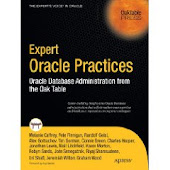
I haven't had much time in the recent past to write interesting blog posts, and the main reason for this is that I was very busy during the last couple of months - in particular contributing to the latest OakTable book "Oracle Expert Practices: Oracle Database Administration from the OakTable" by APress. It has been a very interesting experience - I've been co-authoring two chapters about Performance Optimization Methods together with another OakTable member: Charles Hooper.
This was a real collaborative work, a joint-effort if you want to say so. We exchanged the chapter contents rather frequently via Internet and I think this approach worked out quite well. I also have to thank Charles for spending a lot of time in rewording most of my "german" English into something that was consistent with his style.
It actually worked so well that what was originally planned as a single chapter grew so fast that it was finally decided to split it into two chapters - so we ended up with two chapters each co-authored by two authors.
Although it is obvious that something as complex as Performance Optimization Methods can't be covered to a full extend in a chapter (or even two) and therefore sometimes only the surface could be scratched and countless omissions were necessary I hope that the two chapters help to get a good overview of the available Performance Monitoring and Optimization methods.
I guess that these two chapters are not an easy read - we have packed a lot of details into them, but they should really be worth spending some time to dig through. We have also prepared numerous scripts that can be downloaded at the APress website to reproduce the described methods.
For a full coverage of the Performance Optimization area to me personally Christian Antognini's "Troubleshooting Oracle Performance" is still the benchmark - a very remarkable book.
I really hope that the same will be true for the "Oracle Expert Practices" book - it is supposed to be shipping real soon now.
By the way - it is still a bit early I know, but Charles and myself plan to perform a presentation together about our book chapters at the "Michigan OakTable Symposium (MOTS)" which will take place right before the OOW 2010 on the 16th and 17th of September 2010. So if you're looking for a "technical" conference rather than the more marketing oriented stuff at OOW - this might be interesting for you.
We have some very good ideas about this presentation - it will probably be more or less "zero-slide" and cover lots of demonstrations I guess, but it's too early obviously to reveal too much.
This was a real collaborative work, a joint-effort if you want to say so. We exchanged the chapter contents rather frequently via Internet and I think this approach worked out quite well. I also have to thank Charles for spending a lot of time in rewording most of my "german" English into something that was consistent with his style.
It actually worked so well that what was originally planned as a single chapter grew so fast that it was finally decided to split it into two chapters - so we ended up with two chapters each co-authored by two authors.
Although it is obvious that something as complex as Performance Optimization Methods can't be covered to a full extend in a chapter (or even two) and therefore sometimes only the surface could be scratched and countless omissions were necessary I hope that the two chapters help to get a good overview of the available Performance Monitoring and Optimization methods.
I guess that these two chapters are not an easy read - we have packed a lot of details into them, but they should really be worth spending some time to dig through. We have also prepared numerous scripts that can be downloaded at the APress website to reproduce the described methods.
For a full coverage of the Performance Optimization area to me personally Christian Antognini's "Troubleshooting Oracle Performance" is still the benchmark - a very remarkable book.
I really hope that the same will be true for the "Oracle Expert Practices" book - it is supposed to be shipping real soon now.
By the way - it is still a bit early I know, but Charles and myself plan to perform a presentation together about our book chapters at the "Michigan OakTable Symposium (MOTS)" which will take place right before the OOW 2010 on the 16th and 17th of September 2010. So if you're looking for a "technical" conference rather than the more marketing oriented stuff at OOW - this might be interesting for you.
We have some very good ideas about this presentation - it will probably be more or less "zero-slide" and cover lots of demonstrations I guess, but it's too early obviously to reveal too much.
Sunday, October 25, 2009
UKOUG 2009
I'll be giving two one hour presentations at the upcoming UKOUG conference 2009 at Birmingham (30th November - 2nd December):
1. Monday, 30th November, 16:00-17:00: "CBO fundamentals: Understanding the different modes of System Statistics"
2. Wednesday, 2nd December, 11:05-12:05: "Everything you always wanted to know about FIRST_ROWS_N but were afraid to ask"
Both presentations cover fundamental functionality of the Cost-Based Optimizer which will help you to better understand why and how the optimizer comes up with certain execution plans, and in particular how the underlying cost calculation works. So eventually, if you haven't got an explanation yet I'll show you what the "cost" calculated effectively means and how to appropriately use the different optimization modes (ALL_ROWS, FIRST_ROWS, FIRST_ROWS_n) available.
So if you happen to attend the conference I'm looking forward to meeting you there.
By the way, I recommend visiting this link and save your personalised agenda to help with the room planning.
1. Monday, 30th November, 16:00-17:00: "CBO fundamentals: Understanding the different modes of System Statistics"
2. Wednesday, 2nd December, 11:05-12:05: "Everything you always wanted to know about FIRST_ROWS_N but were afraid to ask"
Both presentations cover fundamental functionality of the Cost-Based Optimizer which will help you to better understand why and how the optimizer comes up with certain execution plans, and in particular how the underlying cost calculation works. So eventually, if you haven't got an explanation yet I'll show you what the "cost" calculated effectively means and how to appropriately use the different optimization modes (ALL_ROWS, FIRST_ROWS, FIRST_ROWS_n) available.
So if you happen to attend the conference I'm looking forward to meeting you there.
By the way, I recommend visiting this link and save your personalised agenda to help with the room planning.
Subscribe to:
Posts (Atom)