As promised in one of my comments here are the slides of the presentations I did at UKOUG 2009.
I've already considered some of the valuable feedback I got - in particular for the FIRST_ROWS_N presentation since it was the first time I did this one.
So those downloads are even valuable for those who attended my sessions - they offer a couple of goodies:
1. The "CBO fundamentals: Understanding System Statistics" slides have a part "The gory details" right after the official end of the presentation where you can find the really "gory" details, if anyone is interested
2. The "Everything You Wanted To Ask About FIRST_ROWS_N But Were Afraid To Ask" presentation has been revised - in particular I have worked on those parts of the slides that were "suboptimal" so far. The complex pagination queries are now better readable and explained step-by-step which I think makes them much simpler to understand, but also some other parts have been re-worked and extended.
Furthermore the slides for this presentation are available in two versions: The presentation slides, and additionally the notes where I explain some more details for those who are interested.
Here are the links to the downloads:
"CBO fundamentals: Understanding System Statistics"
"Everything You Wanted To Ask About FIRST_ROWS_N But Were Afraid To Ask"
"Everything You Wanted To Ask About FIRST_ROWS_N But Were Afraid To Ask" - Notes
Saturday, December 12, 2009


Saturday, December 5, 2009
OakTable Book "Oracle Expert Practices"
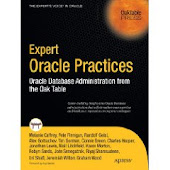
I haven't had much time in the recent past to write interesting blog posts, and the main reason for this is that I was very busy during the last couple of months - in particular contributing to the latest OakTable book "Oracle Expert Practices: Oracle Database Administration from the OakTable" by APress. It has been a very interesting experience - I've been co-authoring two chapters about Performance Optimization Methods together with another OakTable member: Charles Hooper.
This was a real collaborative work, a joint-effort if you want to say so. We exchanged the chapter contents rather frequently via Internet and I think this approach worked out quite well. I also have to thank Charles for spending a lot of time in rewording most of my "german" English into something that was consistent with his style.
It actually worked so well that what was originally planned as a single chapter grew so fast that it was finally decided to split it into two chapters - so we ended up with two chapters each co-authored by two authors.
Although it is obvious that something as complex as Performance Optimization Methods can't be covered to a full extend in a chapter (or even two) and therefore sometimes only the surface could be scratched and countless omissions were necessary I hope that the two chapters help to get a good overview of the available Performance Monitoring and Optimization methods.
I guess that these two chapters are not an easy read - we have packed a lot of details into them, but they should really be worth spending some time to dig through. We have also prepared numerous scripts that can be downloaded at the APress website to reproduce the described methods.
For a full coverage of the Performance Optimization area to me personally Christian Antognini's "Troubleshooting Oracle Performance" is still the benchmark - a very remarkable book.
I really hope that the same will be true for the "Oracle Expert Practices" book - it is supposed to be shipping real soon now.
By the way - it is still a bit early I know, but Charles and myself plan to perform a presentation together about our book chapters at the "Michigan OakTable Symposium (MOTS)" which will take place right before the OOW 2010 on the 16th and 17th of September 2010. So if you're looking for a "technical" conference rather than the more marketing oriented stuff at OOW - this might be interesting for you.
We have some very good ideas about this presentation - it will probably be more or less "zero-slide" and cover lots of demonstrations I guess, but it's too early obviously to reveal too much.
This was a real collaborative work, a joint-effort if you want to say so. We exchanged the chapter contents rather frequently via Internet and I think this approach worked out quite well. I also have to thank Charles for spending a lot of time in rewording most of my "german" English into something that was consistent with his style.
It actually worked so well that what was originally planned as a single chapter grew so fast that it was finally decided to split it into two chapters - so we ended up with two chapters each co-authored by two authors.
Although it is obvious that something as complex as Performance Optimization Methods can't be covered to a full extend in a chapter (or even two) and therefore sometimes only the surface could be scratched and countless omissions were necessary I hope that the two chapters help to get a good overview of the available Performance Monitoring and Optimization methods.
I guess that these two chapters are not an easy read - we have packed a lot of details into them, but they should really be worth spending some time to dig through. We have also prepared numerous scripts that can be downloaded at the APress website to reproduce the described methods.
For a full coverage of the Performance Optimization area to me personally Christian Antognini's "Troubleshooting Oracle Performance" is still the benchmark - a very remarkable book.
I really hope that the same will be true for the "Oracle Expert Practices" book - it is supposed to be shipping real soon now.
By the way - it is still a bit early I know, but Charles and myself plan to perform a presentation together about our book chapters at the "Michigan OakTable Symposium (MOTS)" which will take place right before the OOW 2010 on the 16th and 17th of September 2010. So if you're looking for a "technical" conference rather than the more marketing oriented stuff at OOW - this might be interesting for you.
We have some very good ideas about this presentation - it will probably be more or less "zero-slide" and cover lots of demonstrations I guess, but it's too early obviously to reveal too much.
Subscribe to:
Comments (Atom)